

Quantum Magnonics: Toward Interconnected Quantum Systems
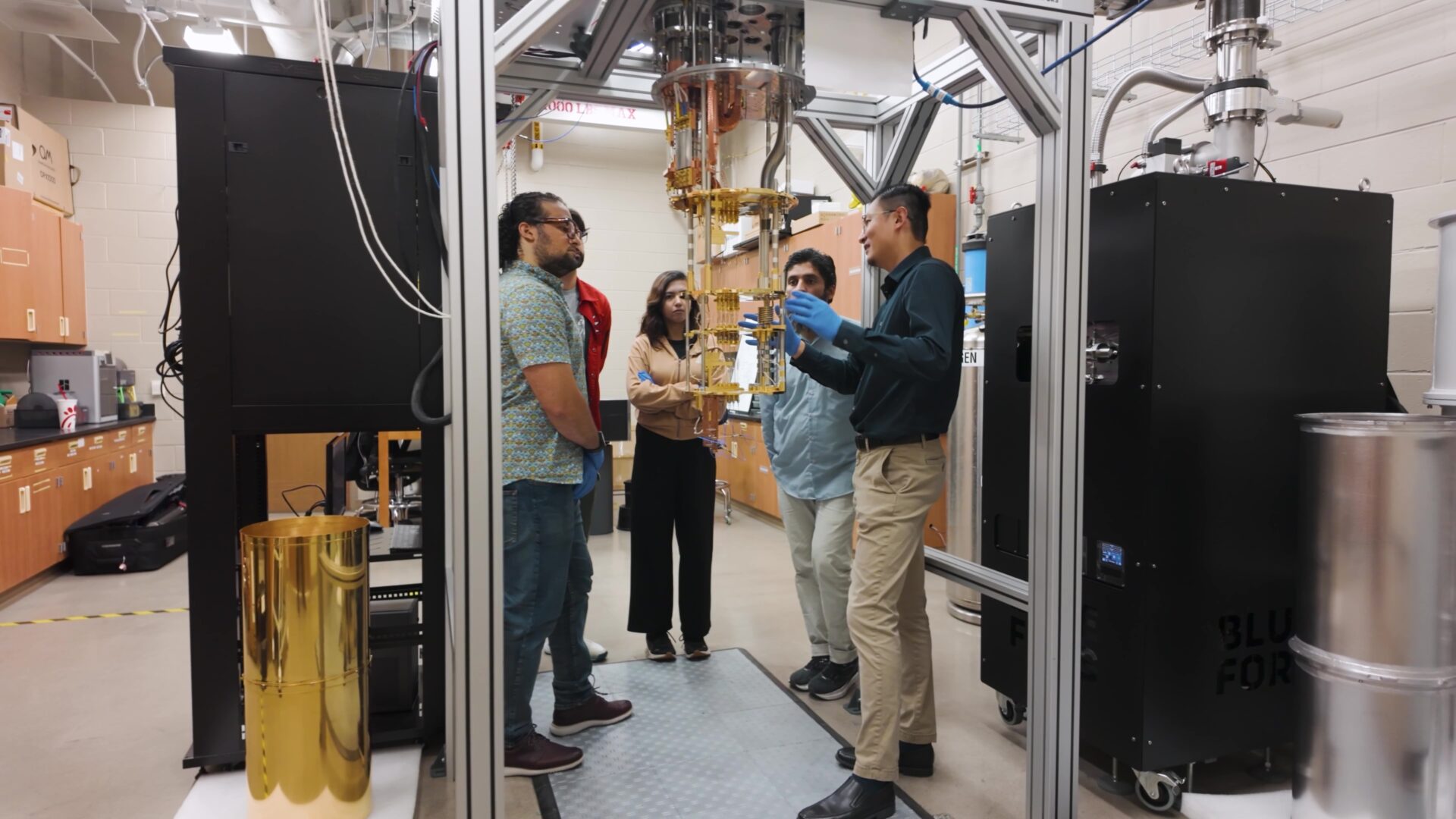
Quantum technology is advancing rapidly, but solving one fundamental challenge could speed up development even further: getting systems from different modalities to communicate effectively with each other. Assistant Professor Jing Xu’s Experimental Quantum Magnetics Laboratory (EQMag Lab) at the University of Central Florida focuses on quantum magnonics, specifically how magnetic excitations – known as magnons – behave inside quantum devices. Research in the lab blends fundamental physics with hands-on engineering – could it hold the key to getting quantum systems talking?
The Missing Link Between Quantum Systems
In Jing’s experimental quantum magnetics lab, his team is tackling an interesting challenge: the lack of interconnection between different quantum systems. Superconducting qubits, optical photons, mechanical resonators, and spin systems all excel at different tasks – processing, transmitting, or storing quantum information – but it is difficult for them to naturally communicate with each other. Solving this challenge will be essential for building scalable, connected quantum computers and quantum networks.
The problem is similar to the one faced in classical information processing, where signals must be converted to a different format to travel efficiently. For example, if you send a message from your phone or laptop to the other side of the world, it may begin as a wireless signal travelling to a router. The router then converts it to an optical signal to send via optical fiber towards its destination. In quantum systems this type of conversion is more challenging because quantum information can be easily disrupted during transfer. On top of this, different quantum platforms rely on fundamentally different physical processes.
To make this conversion more reliable, researchers are working to develop reliable quantum transducers – devices that can convert information between these incompatible platforms without degrading delicate quantum states. Magnons are a promising solution as they can couple strongly to microwave, optical, and mechanical systems while remaining highly tunable through magnetic fields. This enables different quantum technologies to interface seamlessly.
What are Magnons?
Magnons are atomic-scale waves that form when the direction of magnetic moments or spins in a material change in a collective way. These waves can be controlled to flow through the magnetic material and interact with different quantum systems, allowing information to be carried and exchanged between them.
“Magnons are useful for quantum systems because they can interact with many different quantum platforms and excitations, such as photons, phonons, and superconducting qubits,” explains Jing. “Magnons can also be fabricated and controlled to integrate with today’s popular quantum systems, serving different roles such as information processing and transduction. Quantum magnonics is an emerging field with an increasing number of people working to turn these advantages into practical applications that advance the next generation of quantum devices.”
Putting Quantum Theory into Practice
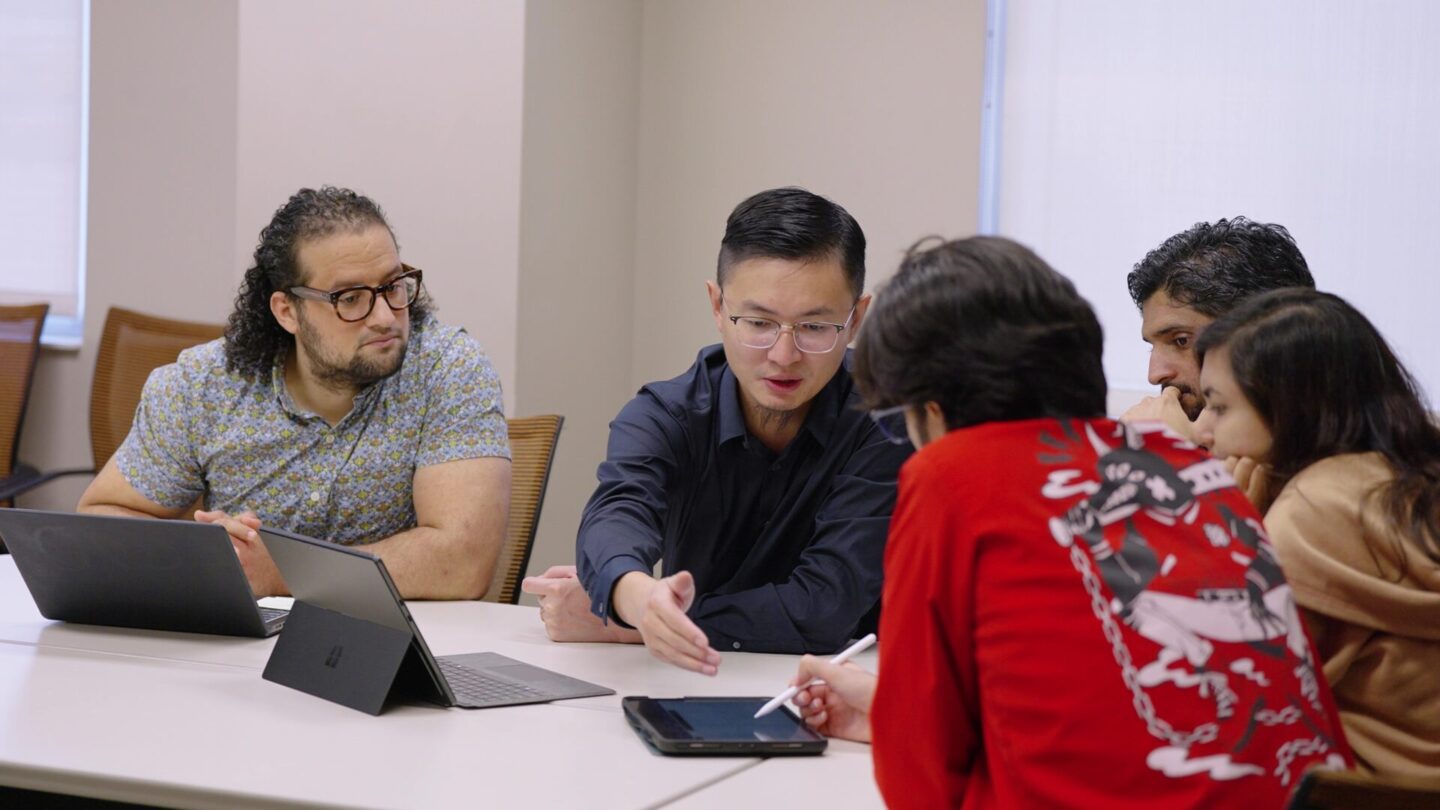
The workflow in Jing’s lab cycles through device design, nanofabrication, measurement, and iteration. Each experiment is designed to couple magnetic materials with different quantum media. “Our main objective is to build an interface between magnons and microwave photons, which is quantized by the superconducting qubit in quantum circuits,” shares Jing. “We also want to couple with other degrees of freedom, such as phonons and optical photons.”
Jing’s team designs, fabricates, and tests hybrid chips that combine magnetic materials with superconducting circuits and, in some cases, optical or mechanical components. All the relevant components are integrated on a single chip, depending on the specific physical phenomena being studied. This allows the team to precisely control interactions and test whether magnons can reliably transfer signals from one quantum modality to another.
Combining magnetic materials with superconducting circuits presents a fundamental challenge: magnetic fields can disrupt superconductivity. “Superconducting systems don’t necessarily like to be affected by a magnetic field, but we can make them work together,” explains Jing. “Type I superconductors are diamagnetic, and a strong magnetic field can kill their superconductivity. But we use Type II superconductors, which can be penetrated by a magnetic field in the form of vortices. If we slow down the motion of the vortices, or keep the vortices still, we can preserve the superconductivity.”
There are several ways to slow or stop vortex movement. “We can fabricate holes on the thin film of the superconductor so that it acts as a pinning center for the superconducting vortices,” says Jing. “We can also use magnetic materials to attract the vortices to slow down or stop, preserving the superconductivity. Superconductors with higher critical temperatures can also preserve superconductivity better than ones with lower critical temperatures. Finally, we can use a high frequency signal in the gigahertz or even up to the terahertz region to control the quantum circuits while preserving the superconductivity.”
A First for Quantum Information Research in Florida
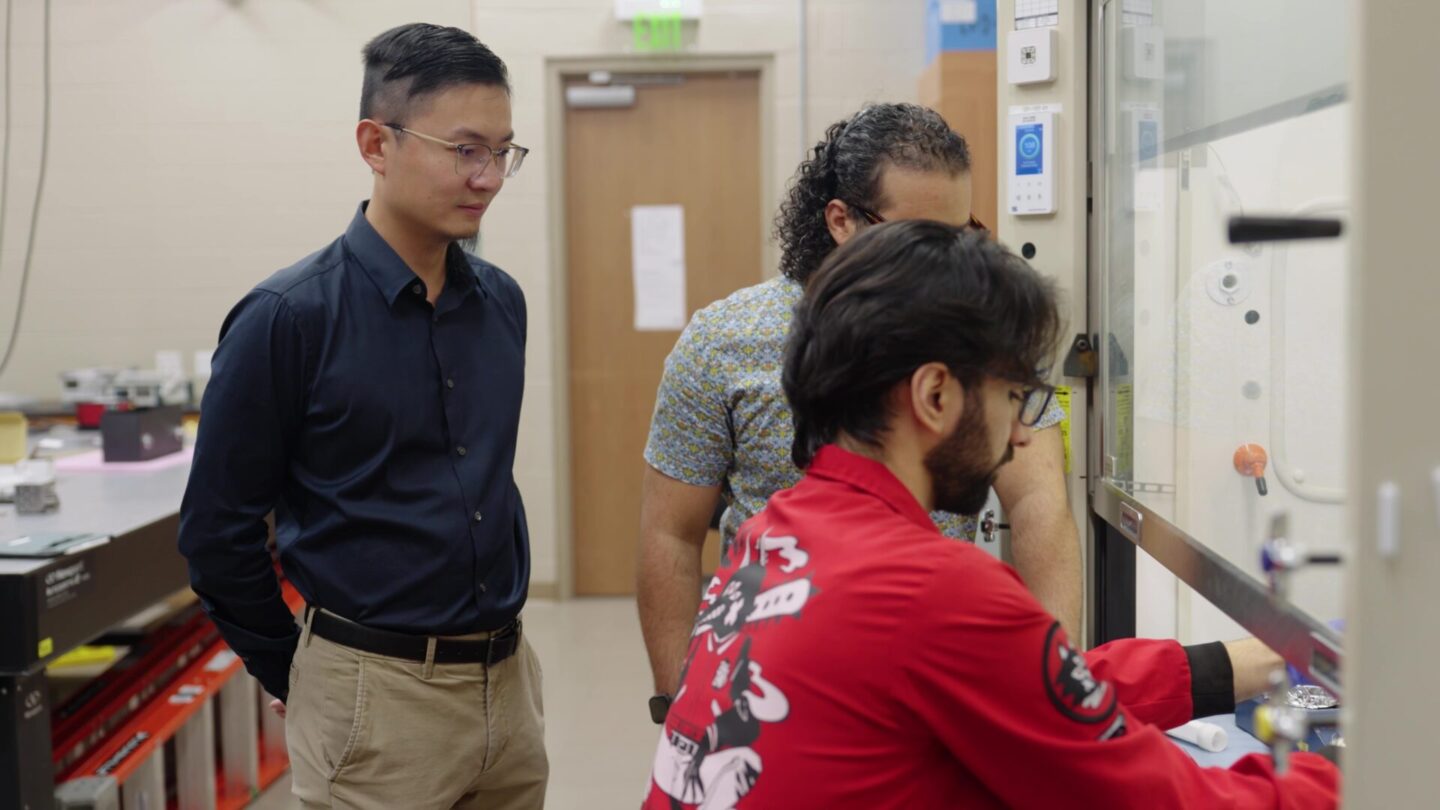
To help Jing and his team iterate on their devices quickly, they rely on a variety of equipment available at the university to support their experimental work, including advanced lithography, deposition, and etching machines. “Having full nanofabrication capability on campus is valuable because a fast turnaround is very important for new research areas like quantum magnetics,” Xu explains. “We can fabricate a device using the on-campus facilities, cool it down in our cryostat, measure it with electronics, study the result, optimize the parameters, and repeat the process. Achieving a short cycle greatly enhances the efficiency of our research and means our students get more hands-on practice with everything from design to fabrication to measurement.”
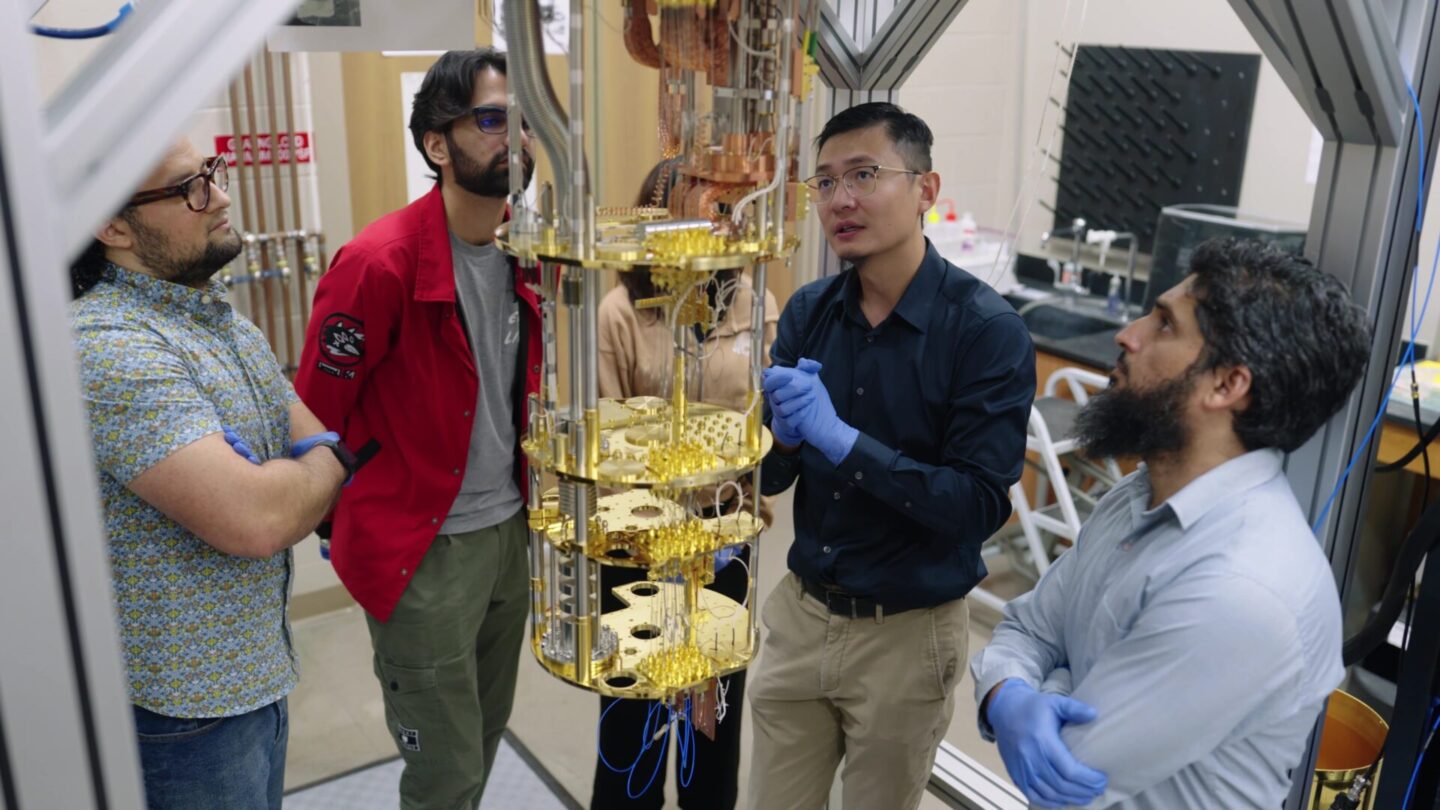
To achieve a quantum state on their devices, the team uses a Bluefors LD400 dilution refrigerator – the first dilution refrigerator dedicated to quantum information science research in Florida. “The quantum state is very fragile so we need to reach a temperature of several millikelvin – about two orders of magnitude colder than outer space,” explains Jing. “If we can’t reliably achieve this temperature, random thermal excitation will break the quantum coherence and destroy all the quantum states we’ve prepared. I really appreciate the Bluefors system – it goes from room temperature to 10 millikelvin in about 22 hours. That’s really fast and a big contrast to working with the old style of cryostats, where the cooldown process could take several days or weeks.”
Jing and his team also appreciate the reliability of the dilution refrigerator. “Because the Bluefors refrigerator is so convenient and so stable, we can spend weeks testing devices in a stable environment, bookended by less than one day for cool down and less than one day for warm up,” shares Jing. “This dramatically increases the amount of experimental time. This is not only a boost to our research process, but also gives our students more exposure to advanced quantum technologies – giving them the skills to be better researchers or workers in the future.”
A Unique Career Path Driven by Curiosity
Jing has always kept one eye on practical applications for scientific research. His path into quantum physics began with a desire to understand the universe, both mathematically and scientifically. As an undergraduate, he started with fundamental physics and then looked at where he could put his knowledge and passion to work in the real world.
That led to him discovering experimental quantum research: “I found there is a unique career path working as a scholar driven purely by curiosity – a career devoted to exploring unanswered questions,” explains Jing. “And what field of physics contains the most unsolved problems and non-intuitive phenomena? Quantum research.”
Jing and his team blend fundamental physics with hands-on engineering to turn abstract concepts into measurable, real-world experiments. “We are trying to find which theories are interesting to explore,” says Jing. “But more interesting for me is our capability to do device fabrication, pass the device behavior, study the result, and repeat the process. It’s exciting to study abstract quantum concepts that are not so intuitive, then verify our theories on our instruments. I still remember how exciting it was the first time I observed textbook quantum coherence when we were doing Ramsey fringe measurements on a transmon qubit device. The best part is I can now do practical quantum experiments together with my students, so we can train the next generation of scientists to push quantum research to the next level.”
A New Hub for Multi-dimensional Quantum Knowledge
Looking ahead, Jing thinks magnons will be very important for future quantum architectures. “Magnons have a lot of unique advantages,” he points out. “They have good compatibility with other quantum systems and great frequency tunability. Magnonic devices can also occupy a very small footprint – compared to a microwave resonator, magnetic thin films need a fraction of the space to realize the same information density. This will be very important in the scaled-up systems of the future.”
Jing hopes that the University of Central Florida can become a hub for quantum research in the state, and encourages other players to reach out. “Building a good ecosystem is very important for quantum research across Florida,” he says. “In the future, we hope multiple institutes, research labs, national labs, and industry players will take part. This will give us a strong network for our students to learn about quantum phenomena, to discuss with different collaborators, and build multi-dimensional knowledge about what skills the future quantum industry will need. I am looking forward to the collaboration.”
Through hands-on research and with the help of advanced cryogenic technology, Jing and his team at the University of Central Florida are working together to ensure the quantum systems of tomorrow can work together too.