

Bluefors Research Derives the Limits of Quantum Computer Wiring Density
In a paper published today in Physical Review Letters, researchers at Bluefors ask a question the field has largely treated as an engineering matter and answer it as a question of physics: how closely can the microwave lines controlling a superconducting quantum processor be packed together before the interconnect itself corrupts the operations it is built to deliver?
Today’s superconducting qubits are addressed by microwave pulses that travel from room temperature electronics to chips operating at millikelvin temperatures inside a dilution refrigerator. As processors grow toward larger qubit counts, the number of control lines also increases, creating the need for higher-density wiring solutions. Among the approaches being explored is flexible printed circuit (FPC) technology, which can accommodate many microwave control lines within a compact, laminar structure. However, bringing signal lines closer together can increase microwave crosstalk: signal leaking from one line into its neighbors. Determining this limit is therefore an essential consideration for high-fidelity quantum systems with large numbers of qubits.
The paper, What Is the Maximum Density of Microwave Control Lines in a Superconducting Quantum Computer?, investigates the fundamental physics that determines these limits. Instead of treating the signal path and the quantum system as separate objects, the authors follow the control signals and their crosstalk as voltage waves along the wiring and put those waves straight into a two-qubit Hamiltonian. Solving it yields closed-form equations that link how tightly the control lines can be packed to the fidelity of both single-qubit and two-qubit gates.
Defining the Limits of Control Line Density
The researchers found a direct relationship between control line crosstalk and quantum gate fidelity, a measure of how accurately a quantum operation is performed compared to its intended result. To establish that relationship, they measured equal-level far-end crosstalk (ELFEXT) in twelve coupled-stripline pairs on flexible printed circuits, fixing how it maps onto real cable geometry. ELFEXT normalizes the leaked signal to the intended one and is therefore insensitive to the attenuation budget of the line.
Using the measurements, the research team developed a framework that connects microwave design parameters to quantum device performance, making it possible to estimate how crosstalk in the control lines affects the fidelity of quantum operations. Their results show that benchmark average gate fidelity of 99.99% requires an ELFEXT of roughly −43 dB for the single-qubit RX rotation and roughly −73 dB for the two-qubit entangling gate considered. Each additional nine in fidelity requires roughly 10 dB lower crosstalk.
Two-qubit gates are more sensitive to crosstalk than single-qubit gates. The desired interaction in a two-qubit gate is intentionally small, while crosstalk affects the neighboring qubit directly. This means that even a weak stray signal can significantly disrupt the operation, leading to much stricter wiring requirements. The same analysis extends to other two-qubit gate designs, including those that use tunable couplers.
The work also identifies where crosstalk originates in the system. With traditional coaxial wiring, most crosstalk occurs close to the quantum processors, where line shielding is reduced. Densely packed flexible printed circuits behave differently, and in these systems, crosstalk can build up throughout the cryogenic signal path. To analyze this, the researchers divided the system into three parts: the cryogenic wiring, the space transformer, and the processor itself, and calculated how much each contributes to overall crosstalk.
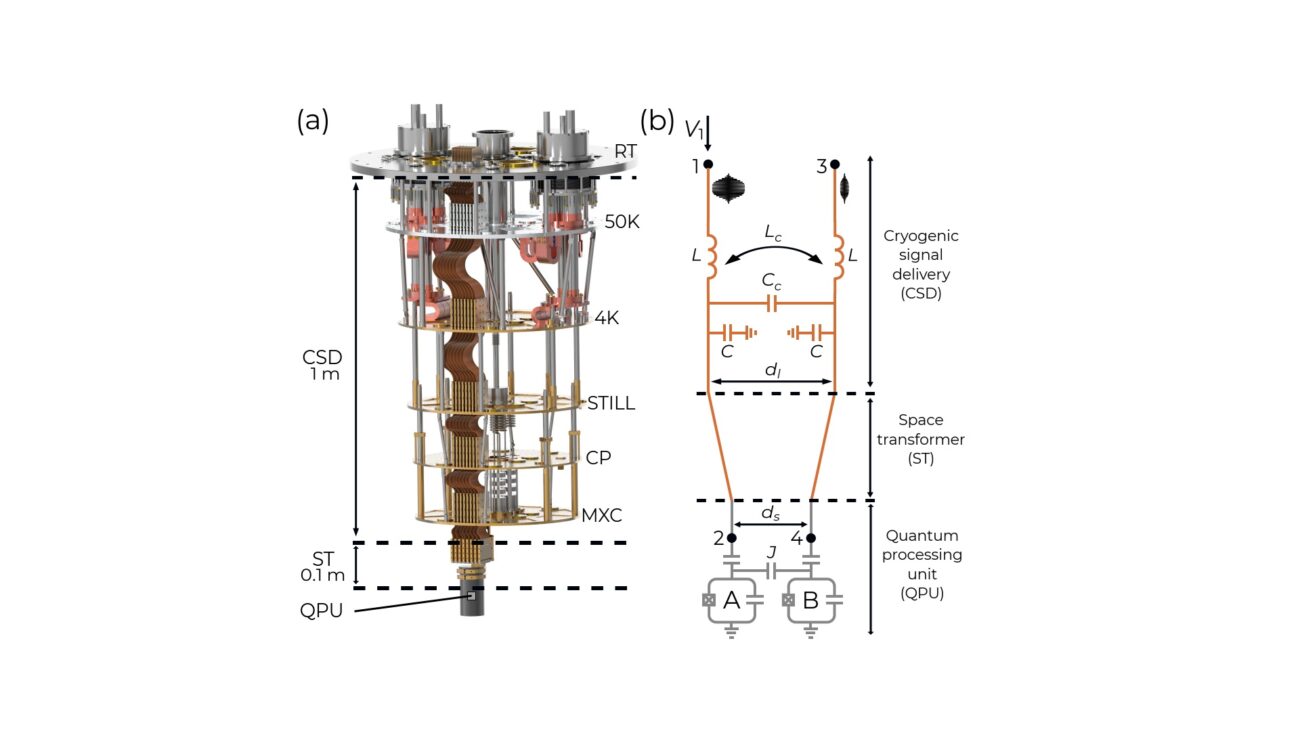
The results reveal a crossover point. With an on-chip pitch of 0.1 mm, this happens when the wiring line pitch falls below roughly 0.23 mm. Below that point, the cryogenic wiring becomes the limiting source of crosstalk in the entire system. Above that crossover, further improving the cable is wasted effort, because the space transformer is the limiting source.
The study also shows how crosstalk can limit the size of a quantum processor. Since every qubit needs its own control line, the fidelity requirements lead into a minimum line pitch and from there into a maximum number of connections around the perimeter of a chip. For a 30 mm square processor, achieving 99.9% two-qubit gate fidelity bounds the device to just under 300 physical qubits. The framework is general and can be applied to many architectures, including a standalone planar processor, 3D-integrated systems, and chiplet-based designs, and it accommodates other line types and circuit Hamiltonians.
“Coherence and addressability aren’t separate problems; they meet in the measurement system, where thermal and electrical effects intertwine. The wiring is in your Hamiltonian whether you like it or not, and that is where this bound comes from,” says Russell Lake, Director, Quantum & Measurement at Bluefors.
The Measurement System as a Quantum Object
The paper is the most recent result of several years of work at Bluefors that treats the measurement chain as a quantum-mechanical object to be characterized and modeled, rather than as passive components to be specified. Together, these Bluefors research papers have progressively examined successive channels through which the chain couples to the qubit:
- Reflection. A 2022 Applied Physics Letters paper showed how reflections in microwave drive lines can reduce single-qubit fidelity.
- Open-system dynamics. A companion 2022 Physical Review A paper connected noise in control lines to decoherence and error rates.
- Thermal noise. A 2024 PRX Quantum paper measured the thermal noise delivered by control lines and tied it to qubit lifetime, dephasing, and gate fidelity.
The stakes rise as control hardware moves into the refrigerator. Signal sources, and increasingly the control electronics themselves, are migrating from room temperature toward the quantum chip, packing more function into the cold stages and binding the signal path more tightly to the qubits it drives. This trend is already visible in recent demonstrations. In a recent study co-authored by Bluefors researchers, a cryo-CMOS chip generated bias voltages for several hundred quantum-dot devices below 70 mK while requiring only digital signals from room temperature.
Once control hardware sits beside the processor like this, where each component belongs and how well it must perform can no longer be fixed by convention; those choices follow from the same physics that governs the qubit. The fidelity bounds derived in this work provide a quantitative framework for making those design decisions. And the case only sharpens as devices improve: the better the qubit, the more of its residual error budget is set by the measurement system around it.