Bluefors Glossary
Explore the Bluefors Glossary to find clear explanations of key terms and concepts used in cryogenics and quantum technology. Whether you’re new to the field or looking to clarify a specific term, the glossary helps you understand the terminology behind quantum technology, cryogenic systems, and their applications.

No terms found.
#
-
4K flange
Learn more about 4K flangeThe 4K flange is a specific temperature stage in dilution refrigerators and cryostats. In a cryogen-free dilution refrigerator, it acts as a structural and thermal anchor plate that is actively cooled to approximately 4 kelvin by the system’s pulse tube cryocooler. At this temperature, the helium-3-helium-4 mixture circulating in the system can be condensed.
-
4K heater
Learn more about 4K heaterA 4K heater is a heater mounted on the 4 K stage of a cryogenic system. It is used to apply controlled heating to the system, helping accelerate warmup and reduce the time required to return the system to room temperature.
-
50K flange
Learn more about 50K flangeThe 50K flange is a specific temperature stage in dilution refrigerators and cryostats. In a cryogen-free dilution refrigerator, it acts as a structural and thermal anchor plate that is actively cooled to approximately 50 kelvin by the system’s pulse tube cryocooler. As the first cooling stage in the system, it helps remove heat from wiring, radiation shields, and other components before they reach colder stages.
A
-
Absolute zero
Learn more about Absolute zeroAbsolute zero is the lowest possible theoretical temperature, defined as 0 kelvin (−273.15 °C or −459.67 °F). At absolute zero, a system reaches its minimum possible thermal energy, and the motion of particles is reduced to the lowest level allowed by quantum mechanics. While absolute zero cannot be reached in practice, cryogenic systems such as dilution refrigerators can cool devices to temperatures just a few millikelvin above it.
-
Adsorber
Learn more about AdsorberAn adsorber is a component that traps gas molecules on the surface of a porous material. In closed-cycle gas compressors used with cryocoolers, they are used to remove impurities from helium circulating in the cryocooler system. Vaporous contaminants become trapped on the filtering media, permitting only helium gas to pass to the cold head.
-
Attenuator
Learn more about AttenuatorAn attenuator is a component that reduces the strength of a signal by a controlled amount. In cryogenic systems, attenuators are commonly installed on microwave signal lines to reduce thermal noise and thermalize the wiring at different temperature stages. This helps deliver clean control signals to quantum devices operating at millikelvin temperatures.
-
Axis
Learn more about AxisAxis is a reference direction in a coordinate system, typically labeled x, y, or z. In cryogenic and quantum systems, axes are used to specify the direction of magnetic fields, measurements, and device orientation.
B
-
Base temperature
Learn more about Base temperatureBase temperature is the lowest stable temperature that a cryogenic system can achieve under specified operating conditions. In a dilution refrigerator, the base temperature is typically measured at the mixing chamber stage and is an important indicator of the system’s cooling performance.
-
Breakout
Learn more about BreakoutA breakout is an interface used to organize and route signals within a system. In cryogenic systems, breakouts serve as connection points between wiring and components, helping distribute signals to devices such as amplifiers, filters, and measurement electronics, both inside and outside the cryostat.
-
By-pass valve (BPV)
Learn more about By-pass valve (BPV)A bypass valve (BPV) is a valve used in the Gas Handling System (GHS) to redirect the flow of the helium-3/helium-4 mixture around specific parts of the circulation circuit. It is used during operating procedures such as cooldown, circulation, maintenance, and system control to manage gas flow within a dilution refrigerator.
C
-
CernOx thermometer
Learn more about CernOx thermometerA CernOx thermometer is a cryogenic temperature sensor in which electrical resistance changes predictably with temperature. It is widely used in cryogenic systems because it provides accurate temperature measurements over a broad temperature range and remains relatively insensitive to magnetic fields.
-
Characterization
Learn more about CharacterizationCharacterization is the process of measuring and evaluating the properties and performance of a device, material, or system. In cryogenic and quantum research, characterization is used to understand how a device behaves under specific conditions, such as low temperatures or applied magnetic fields, and to verify that it performs as intended.
-
Circulation booster
Learn more about Circulation boosterA circulation booster is a component of the Gas Handling System (GHS) that increases the circulation rate of the helium-3/helium-4 mixture in a dilution refrigerator. By boosting the flow of the mixture through the refrigeration circuit, cooling performance an be enhanced to increase available cooling power at millikelvin temperatures.
-
Circulator
Learn more about CirculatorA circulator is a microwave component that routes signals between its ports in a single direction. In cryogenic and quantum systems, circulators are commonly used to direct readout signals from a quantum device to measurement electronics, while isolating the device from unwanted noise and reflections.
-
Coaxial wiring
Learn more about Coaxial wiringCoaxial wiring is a type of wiring that uses a central conductor surrounded by an insulating layer and an outer conductive shield. The shield helps protect signals from electrical interference, making coaxial wiring well suited for carrying high-frequency signals in cryogenic and quantum systems.
-
Cold head
Learn more about Cold headA cold head is a component of a cryocooler where gas is expanded and cryogenic cooling occurs. In dilution refrigerators, the cold head is placed within the cryostat and provides the initial cooling stages, typically at temperatures of around 50 K and 4 K.
-
Cold Helium Circulation System (CHCS)
Learn more about Cold Helium Circulation System (CHCS)A Cold Helium Circulation System (CHCS) is a cooling system that works by circulating cold helium to transport heat away from components and maintain cryogenic temperatures. Cooling is provided by a remote cryocooler that has no direct mechanical connection to the cooled system, helping isolate sensitive applications from vibration.
-
Cold plate
Learn more about Cold plateThe cold plate is a flange in a dilution refrigerator located between the still flange and the mixing chamber flange. Typically operating at a temperature of approximately 100-120 mK, it serves as an intermediate thermalization stage. The cold plate helps intercept heat and provides thermal anchoring for wiring, components, and experimental hardware before they reach the mixing chamber, the coldest stage of the refrigerator.
-
Cold trap
Learn more about Cold trapA cold trap is a cooled component used to capture gases and vapors before they reach other parts of a vacuum or cryogenic system. In dilution refrigerators, cold traps help remove impurities from the circulating helium mixture, supporting reliable operation and cooling performance.
-
Condensation
Learn more about CondensationCondensation is the process by which a gas becomes a liquid when cooled. In dilution refrigerators, helium gases are cooled until they condense, producing the liquid helium required for ultra-low-temperature refrigeration.
-
Condensed matter physics
Learn more about Condensed matter physicsCondensed matter physics is the branch of physics that studies the behavior of electrons and atoms in solid and liquid materials. It seeks to understand how collective interactions between large numbers of particles give rise to material properties such as superconductivity, magnetism, and electrical conductivity, which underpin many quantum technologies.
-
Condensing line
Learn more about Condensing lineIn dilution refrigerators, the condensing line is an isolated return path that takes helium gas from the circulation, precools and condenses it, and delivers it back into the mixing chamber to maintain continuous helium circulation and cooling.
-
Connector box
Learn more about Connector boxThe connector box is a wiring interface on top of the room temperature flange of Bluefors cryogenic measurement systems. Standard Bluefors dilution refrigerator system wiring consists of eight resistor channels for system thermometry and four heater channels for controlling the system. The wiring terminates in the connector box, which facilitates further connections to the Bluefors Temperature Controller.
-
Control line
Learn more about Control lineA control line is a signal line used to deliver control signals to a device inside a cryogenic system. For example, in quantum computing control lines carry precisely shaped electromagnetic pulses that manipulate qubit states and perform quantum operations.
-
Cooldown
Learn more about CooldownCooldown is the process of lowering a cryogenic system and its contents from room temperature to the system’s base temperature. In a dilution refrigerator, cooldown occurs in stages, using a pulse tube cryocooler and a helium-3/helium-4 dilution unit to gradually reach temperatures in the millikelvin range. The duration of the cooldown depends on factors such as system size, thermal mass, and experimental setup.
-
Cooling insert
Learn more about Cooling insertA cooling insert is a removable cryogenic insert designed to cool samples or experimental payloads to low temperatures inside a cryogenic system. The insert provides a thermally controlled environment for experiments and can be equipped with wiring, sample mounting interfaces, and other experimental connections.
-
Cooling power
Learn more about Cooling powerCooling power is a measure of how much heat a cryogenic system can remove at a given temperature. It determines the system’s ability to maintain low temperatures while cooling samples, wiring, and other components that introduce heat into the cryogenic environment. More cooling power allows the system to support larger heat loads while maintaining its target temperature. Cooling power is measured as watts, which quantifies the amount of heat load removed.
-
Crosstalk
Learn more about CrosstalkCrosstalk is the unwanted leakage of high-frequency microwave signals from one transmission line or circuit into an adjacent one. It can introduce noise and signal interference, degrading the performance of superconducting quantum computers and other sensitive cryogenic systems, for example.
-
Cryo-CMOS
Learn more about Cryo-CMOSCryo-CMOS refers to CMOS electronics designed to operate at cryogenic temperatures. By moving control, readout, and signal-processing electronics from room temperature into the cryostat and closer to quantum devices, Cryo-CMOS technology can help reduce wiring complexity and improve the scalability of quantum computing systems.
-
Cryocooler
Learn more about CryocoolerA cryocooler is a mechanical refrigeration device that generates cryogenic temperatures without the continuous use of liquid cryogens such as helium. Cryocoolers are used in many types of cryogenic systems and come in several forms, including pulse tube and Gifford-McMahon cryocoolers. In cryogen-free dilution refrigerators, they provide the initial cooling stages that enable temperatures of a few kelvin to be reached.
-
Cryogen-free
Learn more about Cryogen-freeA cryogen-free cryostat or dilution refrigerator is a closed-loop system that utilizes a cryocooler for pre-cooling the system, instead of utilizing a liquid helium or liquid nitrogen bath to operate. This means that the cryogens used are circulated in a closed-loop without users having to manually handle them. Compared to older systems, which required continuous refills of liquid cryogens used, they enable continious, automated, and cost-efficient operation of low-temperature systems.
-
Cryogenic blackbody source
Learn more about Cryogenic blackbody sourceA cryogenic blackbody source is a device designed to emit thermal radiation that mimics the characteristics of a blackbody at cryogenic temperatures. It provides a stable, well-characterized low-background radiation environment for calibrating, testing, and characterizing cryogenic detectors, sensors, and measurement systems.
-
Cryogenic environment
Learn more about Cryogenic environmentA cryogenic environment provides the low-temperature conditions required for operating cryogenic systems and experiments. It is typically isolated from the surrounding environment using vacuum insulation and thermal shielding methods to minimize heat transfer and thermal noise. Cryogenic environments are used in fields such as quantum computing, superconductivity, and low-temperature physics.
-
Cryogenic measurement system
Learn more about Cryogenic measurement systemA cryogenic measurement system is a platform used to perform measurements on devices and materials at cryogenic temperatures. It combines cooling technology, wiring, and instrumentation in a single system.
-
Cryogenic probe
Learn more about Cryogenic probeA cryogenic probe is a device used to make a temporary connection to a sample, device, or circuit for measurement or testing. Probes can be used to deliver signals to a device, measure responses, or both. In cryogenic applications, probes enable the characterization of devices at low temperatures without requiring permanent electrical connections.
-
Cryogenic temperature
Learn more about Cryogenic temperatureCryogenic temperatures are extremely low temperatures, typically below 120 K (−153 °C). At these temperatures, certain materials exhibit unique phenomena such as superconductivity, enabling applications in quantum computing and low-temperature research.
-
Cryogenic Variable-Temperature Noise Source (CVTNS)
Learn more about Cryogenic Variable-Temperature Noise Source (CVTNS)A Cryogenic Variable-Temperature Noise Source (CVTNS) is a cryogenic device that produces a controllable noise signal. It is used to test, characterize, and calibrate amplifiers, cables, and other measurement components by providing a known noise source at different temperatures. By providing a known microwave thermal noise source and feeding the signal it has created to the device under test, it’s possible to measure the resulting signal and identify how much noise the device itself is adding to the signal.
-
Cryogenic Wafer Prober (CWP)
Learn more about Cryogenic Wafer Prober (CWP)A Cryogenic Wafer Prober (CWP) is a system used to test quantum and superconducting devices fabricated on wafer at cryogenic temperatures. It allows large numbers of devices to be measured and characterized at the low temperatures at which they will operate. This helps speed up device development and optimization.
-
Cryogenics
Learn more about CryogenicsCryogenics is the science and technology of producing, maintaining, and using extremely low temperatures. It plays a key role in fields such as quantum computing, superconductivity, medical imaging, and low-temperature research.
-
Cryoprobing
Learn more about CryoprobingCryoprobing is the characterization and measurement of devices at cryogenic temperatures using probes that make temporary contact with a device or wafer. It is commonly used to evaluate the performance of semiconductors, superconducting devices, and quantum technologies before the devices are packaged or integrated into larger systems.
-
Cryostat
Learn more about CryostatA cryostat is a device that creates and maintains a cryogenic environment. It cools and houses samples, devices, or experiments at very low temperatures while providing controlled access for wiring, measurements, or other instrumentation.
-
Cryostat frame
Learn more about Cryostat frameThe cryostat frame is the structural support that a cryostat is mounted on.
D
-
Dilution refrigerator (DR)
Learn more about Dilution refrigerator (DR)A dilution refrigerator (DR) is a cryogenic system that uses a circulating mixture of helium-3 and helium-4 to reach temperatures below 10 millikelvin. It is the most widely used technology for achieving the ultra-low temperatures required in quantum computing, condensed matter physics, and other low-temperature experiments.
-
Dilution unit
Learn more about Dilution unitThe dilution unit is the part of a dilution refrigerator that generates temperatures in the millikelvin range by circulating a helium-3/helium-4 mixture. It receives the pre-cooled helium mixture from the refrigerator’s higher-temperature cooling stages and cools it further through the dilution process, in which helium-3 moves from a concentrated phase into a dilute phase. The dilution unit contains components such as the still, heat exchangers, and mixing chamber, which work together to circulate the helium isotopes and provide continuous ultra-low-temperature refrigeration.
-
Drive line
Learn more about Drive lineA drive line is a type of control line used to manipulate qubits. It delivers precisely shaped microwave or radio-frequency pulses from room-temperature electronics to a quantum device.
E
-
Electromagnetic compatibility (EMC)
Learn more about Electromagnetic compatibility (EMC)Electromagnetic compatibility (EMC) is a measure of the ability of electronic equipment to operate correctly in the presence of electromagnetic interference without causing interference to other equipment. In cryogenic and quantum systems, good EMC helps ensure reliable operation, accurate measurements, and low-noise performance.
-
Electromagnetic shielding
Learn more about Electromagnetic shieldingElectromagnetic shielding is the use of conductive or magnetic materials to reduce unwanted electromagnetic interference. It helps protect signals, devices, and measurements from external electrical and magnetic noise that might otherwise interfere with or influence resuts and measurements.
-
Electronics rack
Learn more about Electronics rackAn electronics rack is a cabinet that houses the electronic instruments used to control, monitor, and measure a cryogenic system. It typically contains equipment such as temperature controllers, power supplies, signal generators, and readout electronics. The electronics rack is located outside the cryostat at room temperature.
-
Entanglement
Learn more about EntanglementEntanglement is a quantum phenomenon in which the quantum state of two or more particles or qubits cannot be described independently of the state of the others, even when they are separated by a large distance. As a result, measuring one particle or qubit provides information about the others. These correlations can be used in quantum technologies to process information, transmit information, and improve the precision of measurements.
-
Evaporator chamber
Learn more about Evaporator chamberThe evaporator chamber is the part of a helium evaporator measurement system where liquid helium is evaporated to generate cooling. As the helium evaporates, it absorbs heat from its surroundings, enabling operation at sub-kelvin temperatures. The evaporator chamber is located at the coldest part of the system and is thermally connected to the evaporator flange.
-
Evaporator flange
Learn more about Evaporator flangeThe evaporator flange is the flange associated with the evaporator stage of a helium evaporator measurement system. It serves as a mounting and thermalization point for samples, wiring, and experimental hardware that require low temperatures.
-
Evaporator shield
Learn more about Evaporator shieldAn evaporator shield is a thermal radiation shield surrounding the evaporator stage of a helium evaporator measurement system. It helps reduce heat transfer from warmer parts of the system to the evaporator, improving cooling efficiency and supporting lower operating temperatures.
-
Experimental flange
Learn more about Experimental flangeAn experimental flange is a flange designed for mounting and interfacing experimental hardware within a cryogenic system. It provides a mechanical, thermal, and electrical interface between the cryostat and the devices, wiring, or components used in an experiment.
-
Experimental space
Learn more about Experimental spaceThe experimental space is the area within a cryogenic system where samples, devices, and supporting hardware are installed. The size of the experimental space determines how much equipment can be accommodated inside the cryostat.
F
-
Fast Sample Exchange (FSE)
Learn more about Fast Sample Exchange (FSE)Fast sample exchange (FSE) is a feature that allows samples to be swapped from a cryogenic system without warming up the entire system to room temperature. By reducing the time required to change samples, FSE enables faster testing, measurement, and characterization.
-
Fault-tolerant quantum computing (FTQC)
Learn more about Fault-tolerant quantum computing (FTQC)Fault tolerant quantum computing (FTQC) aims to make complex, large scale calculations possible by using quantum error correction codes to combine physical qubits into more reliable logical qubits, correcting the errors caused by quantum decoherence before they accumulate and corrupt the result.
-
Flange
Learn more about FlangeA flange is a metal plate used to connect, support, and seal components in a vacuum or cryogenic system. In dilution refrigerators, flanges form structural interfaces between different parts of the cryostat and can also serve as mounting points for wiring, instruments, and experiments.
-
Flexible printed circuit (FPC)
Learn more about Flexible printed circuit (FPC)A flexible printed circuit (FPC) is a flexible electrical circuit consisting of conductive traces patterned on a thin, bendable substrate. Compared to conventional wiring, FPCs provide a compact and lightweight way to route signals in cryogenic systems while introducing less heat load. They can be used to increase wiring density in applications such as quantum computing.
-
Flowmeter
Learn more about FlowmeterA flowmeter is an instrument used to measure the rate at which a fluid (liquid or gas) moves through a system. In a dilution refrigerator, the flowmeter measures the circulation rate of the helium mixture in the refrigeration loop. The flow reading helps to monitor system performance, as the cooling power of the dilution refrigerator depends strongly on the helium circulation rate.
-
Flux line
Learn more about Flux lineA flux line is a control line used to adjust the magnetic flux applied to a superconducting qubit or circuit. By changing the magnetic flux, a flux line can be used to tune qubit properties such as frequency and enable specific quantum operations.
-
Flux qubit
Learn more about Flux qubitA flux qubit is a type of superconducting qubit, which consists of a superconducting loop interrupted by one or more Josephson junctions. Its two basis states are a persistent current circulating clockwise or anticlockwise through the loop, equivalent to the magnetic flux pointing up or down. The qubit’s energy levels are tuned by adjusting the external magnetic flux threading the loop (a nearby on-chip bias line carries a current that couples inductively to the loop, with a DC line setting the static operating point and a fast flux line providing pulsed control during operations). Gate operations are performed with microwave pulses.
-
FSE insert
Learn more about FSE insertA movable insert used in a Fast Sample Exchange system that houses the experimental sample and interfaces with the cryostat. It incorporates the sample space, thermalization stages, wiring interfaces, and support structures that allow samples to be exchanged quickly while minimizing system downtime.
G
-
Gas Handling System (GHS)
Learn more about Gas Handling System (GHS)The Gas Handling System (GHS) is a subsystem of a dilution refrigerator that stores, circulates, purifies, and controls the helium-3/helium-4 mixture used for cooling. It manages the flow and pressure of the gas mixture throughout the refrigeration process, enabling stable operation.
-
Gate-based quantum computing
Learn more about Gate-based quantum computingGate-based quantum computing is an approach to quantum computing in which quantum operations are performed by applying a sequence of quantum gates to qubits. Similar to the way classical computers use logic gates to process bits, quantum gates manipulate qubit states to perform computations. Gate-based quantum computing is the most widely used approach for building general-purpose quantum computers and forms the foundation for many quantum algorithms.
-
Gifford-McMahon cryocooler (GM)
Learn more about Gifford-McMahon cryocooler (GM)A Gifford-McMahon cryocooler (GM) is a type of cryocooler that generates cryogenic temperatures by cyclically compressing and expanding helium gas. It uses a moving displacer to produce cooling and is commonly used in cryogenic systems to reach temperatures of a few kelvin.
H
-
Heat exchanger
Learn more about Heat exchangerA heat exchanger is a component that transfers heat from one fluid or solid to another. Heat exchangers are used throughout cryogenic systems, including cryocoolers and dilution refrigerators, where they enable cooling processes by transferring heat. In a dilution refrigerator, heat exchangers are integrated components on the pulse tube cryocooler and in the dilution unit. In the dilution unit, they are situated between the still and Mixing Chamber, where they cool the circulating helium before it reaches the mixing chamber.
-
Heat switch
Learn more about Heat switchA heat switch is a component that controls the transfer of heat between two parts of a cryogenic system. By switching between high and low thermal conductance, it either allows or restricts the flow of heat. In dilution refrigerators, heat switches are used during pre-cooling to help cool the lower stages more rapidly, and are then switched to a low-conductance state to thermally isolate the coldest stages from warmer parts of the system.
-
Helium
Learn more about HeliumHelium is a chemical element that plays a central role in cryogenics. Its boiling point is the lowest of all the elements at −268.928 °C (4.222 K), giving it the ability to remain a liquid at extremely low temperatures, which makes it an effective coolant for reaching and maintaining cryogenic temperatures.
-
Helium bath
Learn more about Helium bathA helium bath is a reservoir of liquid helium that serves as the low-temperature environment in a cryogenic system. Components immersed in or thermally connected to the helium bath are maintained at cryogenic temperatures through thermal contact with the liquid helium. Helium baths are commonly used in applications such as superconducting magnets, MRI systems, and NMR instruments.
-
Helium compressor package
Learn more about Helium compressor packageA helium compressor package is a unit that compresses and circulates helium gas between the compressor and the cryocooler. It provides the high-pressure helium flow required to generate cryogenic temperatures and support the operation of the cooling system.
-
Helium flex line
Learn more about Helium flex lineA helium flex line is a flexible hose that transports helium gas between the helium compressor and the cryocooler. It enables the circulation of high-pressure helium while helping isolate vibrations generated by the compressor.
-
Helium pumping line
Learn more about Helium pumping lineA helium pumping line is an isolated line used to transport helium gas between components of a cryogenic system. In a XLDHehp System and a Cryogenic Wafer Prober, it connects the cryostat to the Gas Handling System (GHS) and supports the circulation of the helium gas required for cooling.
-
Helium recovery
Learn more about Helium recoveryHelium recovery is the process of collecting helium gas from cryogenic equipment so it can be reused instead of being released. Recovered helium is typically stored, purified, and returned to a cryogenic system or helium liquefaction process, helping reduce helium consumption and waste.
-
Helium Recovery System
Learn more about Helium Recovery SystemA helium recovery system collects, stores, and recovers helium gas from cryogenic equipment and processes. Recovered helium can be purified and reused, enabling zero-boil-off operation of cryogenic applications such as superconducting magnets.
-
Helium Reliquefier (HeRL)
Learn more about Helium Reliquefier (HeRL)A helium reliquefier (HeRL) is a helium management system that captures helium gas that has boiled off from a cryogenic application and recondenses it back into liquid helium for reuse. It can be integrated with cryogenic systems such as superconducting magnets, helping reduce helium loss and the need for liquid helium refills.
-
High-density Flex Wiring (FPC)
Learn more about High-density Flex Wiring (FPC)High-Density Flex Wiring (FPC) is a type of high-density wiring based on flexible printed circuit technology. It enables a very large number of signal lines to be routed in a compact format while reducing thermal load and saving space inside the cryostat.
-
High-Density Wiring (HDW)
Learn more about High-Density Wiring (HDW)High-Density Wiring (HDW) refers to high-density coaxial wiring that enables a large number of signal lines to be integrated into a cryogenic system. It is designed to maximize the number of coaxial lines that can be accommodated within the available space in a cryostat while maintaining signal quality.
-
High-electron-mobility transistor (HEMT)
Learn more about High-electron-mobility transistor (HEMT)A high-electron-mobility transistor (HEMT) is a type of transistor designed for high-speed and low-noise operation. In cryogenic systems, HEMTs are commonly used as low-noise microwave amplifiers to amplify very weak signals. In quantum computing, HEMT amplifiers are used in qubit readout lines to amplify signals before they are transmitted to room-temperature electronics for further processing.
-
High-Performance Computing (HPC)
Learn more about High-Performance Computing (HPC)High-Performance Computing (HPC) is the utilization of powerful computer clusters to perform complex calculations and process large amounts of data. By combining many processors and computing resources, HPC systems can perform large-scale simulations, data analysis, and modeling tasks much faster than conventional computers. HPC and quantum computing systems are used together as hybrid computing systems to enable more complex simulations and tasks to be solved. In these hybrid architectures, quantum processors are used as accelerators to solve certain parts of computational workflows more effectively.
-
High-throughput characterization
Learn more about High-throughput characterizationHigh-throughput characterization is the rapid testing and measurement of large numbers of devices or samples. It helps researchers evaluate performance, identify promising designs, and accelerate the development of quantum and other advanced technologies.
I
-
Infrared (IR) filter
Learn more about Infrared (IR) filterAn infrared (IR) filter is a filter that reduces the transmission of infrared radiation. In cryogenic systems, this helps limit heat transfer from warmer parts of the system to colder stages, protecting sensitive devices and maintaining low temperatures. A common application of IR Filters is in superconducting qubit devices where infrared radiation is suspected to reduce the qubit coherence time.
-
Isolator
Learn more about IsolatorAn isolator is a passive microwave component that allows signals to travel in one direction while preventing them from moving in the opposite direction. In cryogenic and quantum computing systems, isolators are used to prevent unwanted signals and noise from traveling back to sensitive devices such as qubits and amplifiers.
J
-
Josephson junction
Learn more about Josephson junctionJosephson junction is a tiny structure made of two superconductors separated by an extremely thin barrier. Because of quantum mechanical effects, pairs of electrons can pass through the barrier without electrical resistance, creating a continuous supercurrent. Josephson junctions are used as a circuit element in superconducting circuits, making them a key building block of many devices, including SQUIDs, superconducting qubits, and quantum limited amplifiers.
-
Joule-Thomson expansion
Learn more about Joule-Thomson expansionJoule–Thomson expansion is the cooling effect that occurs when a gas transitions from high pressure to low pressure, as it passes through a restriction, such as a valve or a small opening, and rapidly expands. This effect is commonly used in cryogenic systems to help cool and liquefy gases such as helium.
K
-
Kelvin
Learn more about KelvinKelvin (K) is the standard unit of temperature used in science and engineering. The Kelvin scale is defined relative to absolute zero (0 K), the lowest possible theoretical temperature, and is commonly used in cryogenics to measure extremely low temperatures.
-
KF port
Learn more about KF portA KF port is a standardized vacuum flange connection used to join components in a vacuum system. It provides a reliable vacuum seal and is commonly used for connecting pumps, gauges, valves, and other vacuum hardware.
-
KIDE Cryogenic Platform
Learn more about KIDE Cryogenic PlatformThe KIDE Cryogenic Platform is a large-scale cryogenic system designed to support the development and operation of industrial quantum computing technologies. It consists of a self-supporting vacuum chamber that provides a low-temperature environment for integrating, testing, and operating quantum computing components and systems.
L
-
Line-of-sight (LOS)
Learn more about Line-of-sight (LOS)Line-of-sight (LOS) refers to a direct, unobstructed path between two points. In Bluefors dilution refrigerators, the term is commonly used to describe wiring ports that provide a continuous path from room temperature to the mixing chamber, allowing wiring and other components to be installed and routed directly through the cryostat.
-
Liquid Helium Plant (LHeP)
Learn more about Liquid Helium Plant (LHeP)A liquid helium plant (LHeP) is a system that liquefies helium gas to produce liquid helium for cryogenic applications. Many liquid helium plants are also used to recover and recycle helium, reducing helium consumption.
-
Liquid nitrogen (LN2)
Learn more about Liquid nitrogen (LN2)Liquid nitrogen (LN₂) is nitrogen in its liquid state, typically stored at a temperature of approximately 77 K (-196° C or -321° F) at atmospheric pressure. It is widely used in cryogenic applications for cooling, pre-cooling, and temperature control due to its low cost and ready availability.
-
LN2 pre-cooling loop
Learn more about LN2 pre-cooling loopA liquid nitrogen (LN₂) pre-cooling loop is a factory-installed cryogenic option used to reduce system cooldown times in dilution refrigerators. It works by circulating liquid nitrogen to help bring the system down from room temperature to roughly 80 kelvin before more extreme cooling processes takes over.
-
LN2 trap
Learn more about LN2 trapAn LN2 trap is a cold trap cooled with liquid nitrogen (LN₂) that removes unwanted gases, vapors, and contaminants from a gas stream. By condensing unwanted gases and vapors onto a cold surface, it helps maintain gas purity and supports reliable system operation.
-
Load lock
Learn more about Load lockA load lock is a chamber that allows samples or components to be transferred into or out of a vacuum system without venting the main vacuum chamber. In a dilution refrigerator, a load lock system such as the Fast Sample Exchange System enables sample loading and unloading while keeping the cryostat under vacuum and cold, reducing system downtime and avoiding a full warm-up cycle.
-
Logical qubit
Learn more about Logical qubitLogical qubit is a quantum bit in which quantum information is encoded across multiple physical qubits to protect it from errors. By using quantum error correction, logical qubits help preserve quantum information during computation. While physical qubits provide the hardware foundation for quantum computing, logical qubits help protect quantum information from noise and errors, enabling more reliable quantum computations.
-
Long-life cold trap
Learn more about Long-life cold trapA long-life cold trap is a cold trap engineered for extended operation, without the need for manual LN2 operation. The cold trap removes gases and vapors from a vacuum system, helping maintain a clean vacuum and reduce maintenance requirements. It also allows systems to be continuously operated for up to three years.
-
Low-noise amplifier (LNA)
Learn more about Low-noise amplifier (LNA)A low-noise amplifier (LNA) is an amplifier designed to boost very weak electrical signals while adding as little additional noise as possible. In cryogenic and quantum systems, LNAs are used to amplify readout signals from quantum devices before they are processed by other electronics.
-
Low-pass filter
Learn more about Low-pass filterA low-pass filter is a component that allows low-frequency signals to pass through while reducing or blocking higher-frequency signals. In cryogenic and quantum systems, low-pass filters are used to suppress unwanted high-frequency noise and help protect sensitive devices and measurements.
M
-
Magnet dummy
Learn more about Magnet dummyA magnet dummy is a mechanically and thermally representative substitute for a superconducting magnet. It is used to operate a magnet system without an actual magnet.
-
Magnetic shielding
Learn more about Magnetic shieldingMagnetic shields are materials or structures used to reduce unwanted magnetic fields around a device or experiment. Shielding helps protect sensitive components and measurements from magnetic interference that could affect results or device performance.
-
Main circulation pump
Learn more about Main circulation pumpThe main circulation pump drives the circulation of helium through a dilution refrigerator. It is a dedicated part of the helium circulation system and continuously removes helium from the still pumping line, enabling the helium to be recondensed and returned to the refrigerator. In Bluefors systems, the main circulation pump is a multistage roots pump designed for continuous operation.
-
Many-body system
Learn more about Many-body systemMany-body systems are systems made up of multiple interacting particles. Studying them helps researchers understand how microscopic quantum behavior can influence the larger-scale properties of materials.
-
Mechanical vibration
Learn more about Mechanical vibrationMechanical vibration is the presence of physical movement in a system or component. In cryogenic and quantum systems, mechanical vibrations can introduce noise, disturb sensitive measurements, and affect the performance of quantum devices.
-
Microwave noise
Learn more about Microwave noiseMicrowave noise refers to unwanted microwave signals or fluctuations that might interfere with the operation of sensitive devices and measurements. In quantum computing and cryogenic experiments, microwave noise can disturb quantum states, reduce measurement accuracy, and degrade device performance.
-
Mixing chamber (MXC)
Learn more about Mixing chamber (MXC)The mixing chamber (MXC) is a chamber within the dilution unit of a dilution refrigerator where helium-3 and helium-4 mix and undergo phase separation. The helium isotopes are mixed together in the chamber, generating the refrigerator’s lowest temperatures, typically in the millikelvin range.
-
Mixing chamber flange (MXC flange)
Learn more about Mixing chamber flange (MXC flange)The mixing chamber flange (MXC flange) is the flange located at the mixing chamber stage—the coldest part of a dilution refrigerator. It provides a mounting surface and thermal anchoring point for samples, devices, wiring, and experimental hardware that require millikelvin temperatures.
-
Modular Cryogenic Platform
Learn more about Modular Cryogenic PlatformThe Modular Cryogenic Platform is a large-scale cryogenic system featuring interconnected modules and housed within a self-standing vacuum chamber. Its modular architecture allows the system to be expanded, reconfigured, or upgraded by adding and/or exchanging modules, supporting the integration and scaling of complex cryogenic and quantum technologies.
N
-
Nanofabrication
Learn more about NanofabricationNanofabrication is the process of designing and manufacturing structures and devices at the nanometer scale. It is used to create components such as quantum devices, superconducting circuits, sensors, and semiconductor structures with features that are only a few millionths of a millimeter in size.
-
Neutral atoms
Learn more about Neutral atomsNeutral atoms are atoms that have no net electric charge because they contain equal numbers of positively charged protons and negatively charged electrons. In quantum computing, individual neutral atoms can be trapped and controlled with laser light, allowing them to serve as qubits.
-
Nitrogen-vacancy (NV) center
Learn more about Nitrogen-vacancy (NV) centerA nitrogen-vacancy (NV) center is a defect in a diamond crystal consisting of a nitrogen atom and a neighboring vacant atomic site. Its quantum properties make it a widely studied platform for quantum sensing and other quantum technologies.
-
NMR spectroscopy
Learn more about NMR spectroscopyAn NMR instrument is an analytical technique that uses nuclear magnetic resonance (NMR) to analyze materials at the atomic level. It measures the response of atomic nuclei to magnetic fields and radio-frequency signals to reveal information about a sample’s composition and structure.
O
-
Optical access port
Learn more about Optical access portAn optical access port is a sealed, optical opening (a tiny window) in a cryogenic system that allows light to enter or exit the cryostat. It provides a path for optical signals, laser beams, or imaging systems to interact with samples and devices inside the cryogenic environment.
-
Optical control
Learn more about Optical controlOptical control is the use of light to manipulate, control, or operate a device or quantum system. Through the application of optical signals, properties such as the state, energy level, or behavior of a device can be changed without direct electrical contact. It can also refer to control methods, in which optical control signals are transduced into electrical signals, for example. In quantum technologies, optical control can be used to initialize, drive, or read out quantum states.
-
Optical Fibers
Learn more about Optical FibersOptical fibers are thin strands of glass or plastic that transmit light signals over long distances with low signal loss. Because they can be flexibly routed, optical fibers make it possible to deliver optical signals to various systems. In cryogenic systems, they are used to deliver and receive signals to and from devices and samples operating in the cryogenic environment, used for example applications in quantum communications, quantum optics and quantum computing.
P
-
Persistent mode switch (PSW)
Learn more about Persistent mode switch (PSW)A persistent mode switch (PSW) is a device used in superconducting magnet systems to switch between powered operation and persistent mode where the current circulates continuously within the superconducting magnet without an external power supply. This helps to maintain a stable magnetic field over long periods.
-
Phase separation
Learn more about Phase separationPhase separation is the formation of two distinct liquid phases within a mixture. In a dilution refrigerator, the helium-3–helium-4 mixture separates into two phases: a helium-3 rich phase (concentrated phase) and a helium-3 poor phase (dilute phase). Approaching absolute zero temperature, the concentrated phase becomes pure He-3 while in the dilute He-4 rich phase there remains 6.6% of He-3. The enthalpy of He-3 in the dilute phase is larger than in the concentrated phase. Hence energy is required to move He-3 atoms from the concentrated to the dilute phase. In a dilution refrigerator this energy is taken from a well isolated environment so cooling will occur.
-
Photon
Learn more about PhotonA photon is the smallest unit (particle) of light and other forms of electromagnetic radiation. Photons carry energy but have no mass, and can be used to transmit information, including in quantum communication and photonic quantum computing.
-
Photonic qubit
Learn more about Photonic qubitA photonic qubit is a quantum bit that uses a single photon to store and carry quantum information. The quantum state can be encoded in photon properties, such as its polarization, phase, or path through an optical system.
-
Physical qubit
Learn more about Physical qubitA physical qubit is a single quantum bit implemented in a physical system, such as a superconducting circuit, trapped ion, neutral atom, or photon. Physical qubits are the basic building blocks of a quantum computer and can be combined to create more fault-tolerant logical qubits through quantum error correction.
-
Pinout
Learn more about PinoutA specification or diagram that defines the electrical function of each contact in a connector or wiring interface. In cryogenic measurement systems, pinouts are used to identify signal, ground, power, sensor, and communication connections between room-temperature electronics and cryogenic components.
-
Pre-cooling
Learn more about Pre-coolingPre-cooling is the process of cooling a cryogenic system from room temperature before it reaches its final operating temperature. In a dilution refrigerator, pre-cooling is performed by a cryocooler, which cools the system to below 4.2 kelvin before the dilution refrigerator cycle begins cooling to millikelvin temperatures. The term can also refer to the pre-cooling of the circulating helium-3/helium-4 mixture before it enters the dilution unit.
-
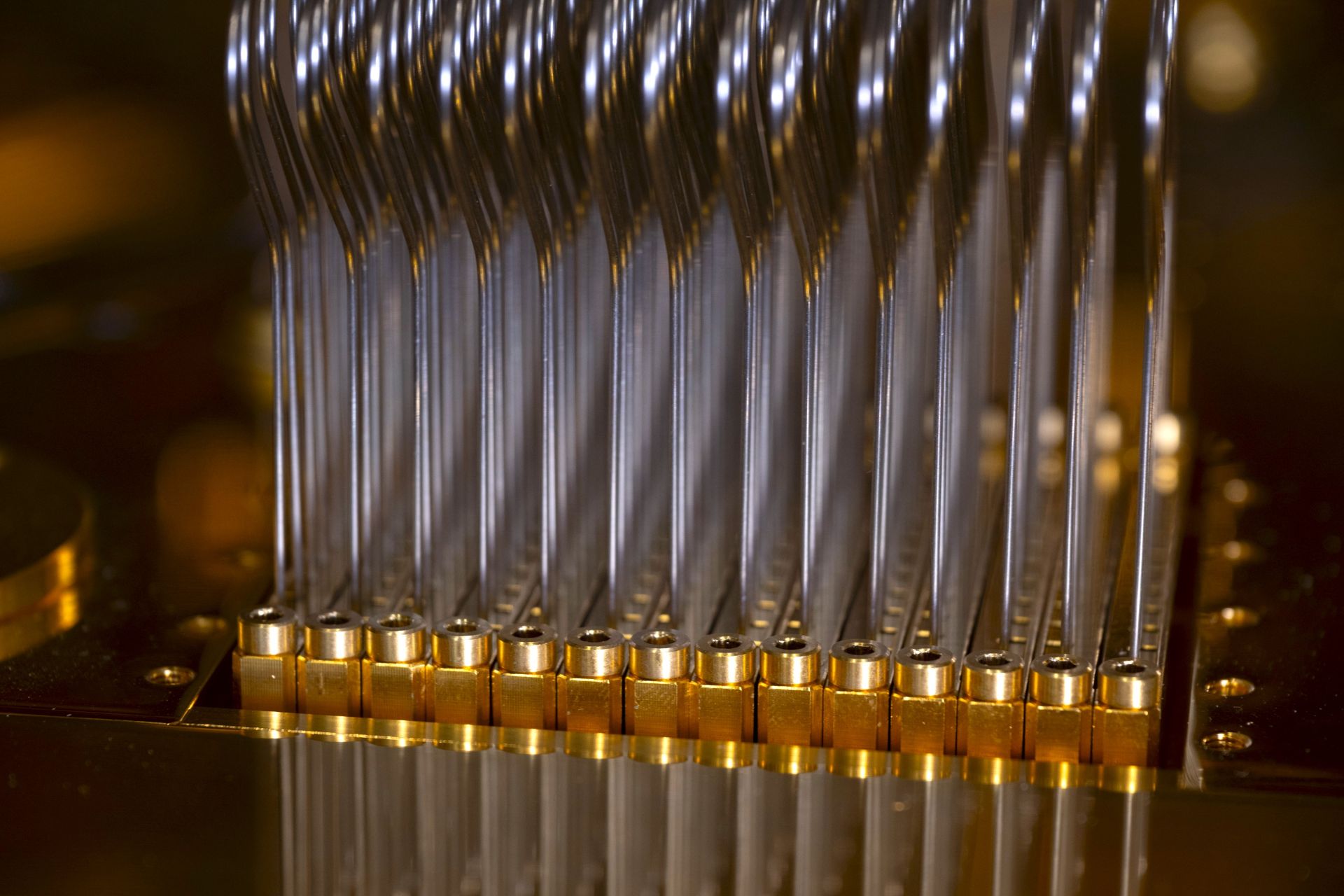
Probe card
Learn more about Probe cardA probe card is an assembly that holds multiple cantilever pins used to make temporary contacts with devices on a wafer during testing. It routes signals between measurement equipment and the devices under test, enabling wafer-level characterization without permanently connecting the devices.
-
Programmable logic controller (PLC)
Learn more about Programmable logic controller (PLC)A Programmable logic controller (PLC) is an industrial computer used to automate and monitor the operation of cryogenic equipment. In dilution refrigerator systems, PLCs are commonly used to control the Gas Handling System (GHS), compressor, cooling process, vacuum operation, temperature regulation, and safety interlocks.
-
Pulse tube cryocooler (PT)
Learn more about Pulse tube cryocooler (PT)A pulse tube cryocooler (PTC) is a type of cryocooler that generates cryogenic temperatures using cyclic pressure changes in helium gas. Because it has no moving parts at the cold end, it provides reliable cooling with low vibration, making it widely used in dilution refrigerators and other cryogenic systems.
Q
-
Quantum algorithm
Learn more about Quantum algorithmA quantum algorithm is a method for solving a computational problem using a quantum computer, exploiting quantum effects such as superposition, entanglement, and interference. It consists of a sequence of quantum operations applied to qubits. Some quantum algorithms can solve specific problems more efficiently than classical algorithms.
-
Quantum chip
Learn more about Quantum chipA quantum chip is a device that contains qubits and the structures needed to control and read them. It serves as the core processing component of a quantum computer, where quantum operations are performed.
-
Quantum circuit
Learn more about Quantum circuitA quantum circuit can refer to either a sequence of quantum operations applied to qubits or a physical electrical circuit that operates according to the principles of quantum mechanics (such as superconducting circuit). In quantum computing, it most commonly describes a sequence of quantum gates used to perform a computation via quantum phenomena such as superposition and entanglement.
-
Quantum communication
Learn more about Quantum communicationQuantum communication is a way of transmitting information using quantum systems, such as photons. Unlike conventional communication technologies, it uses the laws of quantum mechanics to enable applications such as highly secure communication and quantum networks.
-
Quantum computing
Learn more about Quantum computingQuantum computing is a form of computing that uses qubits instead of classical bits to process information and harnesses quantum phenomena such as superposition and entanglement. It is intended to tackle computational problems that are difficult or impractical for classical computers, such as simulating quantum systems, optimizing complex processes, and solving certain mathematical problems.
-
Quantum device
Learn more about Quantum deviceA quantum device is a device that operates using the principles of quantum mechanics, such as superposition, entanglement, or quantum tunneling. Examples include quantum chips containing qubits, quantum sensors, and single-photon detectors. These devices use quantum effects to perform functions that are not possible with classical devices.
-
Quantum dot
Learn more about Quantum dotA quantum dot is a nanoscale semiconductor structure that confines electrons in a very small space. Because the electrons can only occupy specific energy levels, quantum dots are sometimes referred to as “artificial atoms.” Their quantum properties make them useful for applications such as quantum computing, photonics, and sensing.
-
Quantum effect
Learn more about Quantum effectA quantum effect is a physical phenomenon that occurs at the quantum level and cannot be explained by classical physics alone. Examples of quantum effects include superposition, entanglement, and quantum tunneling, which underpin the operation of quantum technologies.
-
Quantum error correction (QEC)
Learn more about Quantum error correction (QEC)Quantum error correction (QEC) is a set of techniques designed to protect quantum information from errors caused by noise and other disturbances. By encoding information across multiple physical qubits, QEC aims to identify and correct errors while preserving the underlying quantum state. It is a key area of research in the development of fault-tolerant quantum computers.
-
Quantum I/O
Learn more about Quantum I/OQuantum I/O refers to wiring, cryoelectronics, filters, amplifiers, and other components used to transmit, condition, and measure signals in a cryogenic system. Together they connect samples and devices operating at cryogenic temperatures to room temperature measurement and control electronics, enabling them to be operated and studied.
-
Quantum information
Learn more about Quantum informationQuantum information is information that is stored, processed, or transmitted using quantum states. Unlike classical information, which follows the rules of classical physics, quantum information can exhibit properties such as superposition and entanglement, enabling new approaches to computation, communication, and sensing.
-
Quantum internet
Learn more about Quantum internetThe quantum internet is a network that connects quantum devices, such as quantum computers, communication systems, and sensors, allowing them to exchange and process quantum information. The quantum internet could enable highly secure communication, connect remote quantum computers into larger computing systems, and improve the performance of distributed quantum sensors.
-
Quantum limited amplifier (QLA)
Learn more about Quantum limited amplifier (QLA)A quantum-limited amplifier (QLA) is a low-noise amplifier that amplifies very weak signals while introducing as little additional noise as physically possible. It is commonly used to read out qubits and other sensitive quantum devices. Traveling-wave parametric amplifiers (TWPAs) are one type of quantum-limited amplifier.
-
Quantum matter
Learn more about Quantum matterQuantum matter refers to materials and physical systems whose behavior is governed by quantum mechanical effects. These effects give rise to properties and phenomena that do not occur in conventional materials, such as superconductivity, superfluidity, and exotic magnetic states.
-
Quantum metrology
Learn more about Quantum metrologyQuantum metrology is the science of making measurements using quantum mechanical effects. By exploiting phenomena such as superposition and entanglement, quantum metrology can improve the precision and sensitivity of measurements beyond what is possible with classical techniques.
-
Quantum optics
Learn more about Quantum opticsQuantum optics is the study of how light behaves according to the principles of quantum mechanics. It examines phenomena such as single photons, quantum states of light, and the interactions between light and matter at the quantum level.
-
Quantum sensing
Learn more about Quantum sensingQuantum sensing is the use of quantum systems and quantum mechanical effects to measure physical quantities with exceptionally high sensitivity and precision. It is an area of quantum technology focused on developing new measurement techniques for applications such as navigation, medical imaging, materials characterization, and fundamental scientific research.
-
Quantum sensor
Learn more about Quantum sensorA quantum sensor is a device that uses quantum mechanical effects to measure physical quantities with high sensitivity and precision. Quantum sensors can detect extremely small changes in quantities such as magnetic fields, electric fields, temperature, gravity, and time.
-
Quantum state
Learn more about Quantum stateA quantum state describes a quantum system at a given moment. It contains the quantum information that defines the system’s properties and determines the possible outcomes of measurements. The ability to create, control, and preserve quantum states is essential for technologies such as quantum computing, quantum communication, and quantum sensing.
-
Quantum tunneling
Learn more about Quantum tunnelingQuantum tunneling is a quantum phenomenon in which a particle can pass through an energy barrier that, in classical physics, it lacks the energy to cross. Quantum tunneling plays an important role in many quantum technologies and devices, including Josephson junctions which form the basis for superconducting qubits.
-
Qubit
Learn more about QubitQubits (quantum bits) are to quantum computing what bit are to classical computing. Similarly to the bit which can have a value 0 or 1 the qubit can be in a state |0⟩ or |1⟩ but also in a superposition of |0⟩ and |1⟩ . Qubits are the fundamental units of quantum information. They can also be entangled with one another, allowing information to be distributed across multiple qubits. By controlling and measuring these quantum states, quantum computers can perform more complex computations than classical computers.
-
Qubit coherence
Learn more about Qubit coherenceQubit coherence is the ability of a qubit to maintain its quantum state over time without losing the quantum information it stores. High coherence, measured by the time of energy relaxation and dephasing, enables more reliable quantum operations and computations.
-
Qubit decoherence
Learn more about Qubit decoherenceQubit decoherence is the process by which a qubit loses its quantum state due to interactions with its environment. As decoherence occurs due to environmental noise, the qubit loses the information its storing, introducing errors and limiting the duration of quantum computations.
-
Qubit dissipation
Learn more about Qubit dissipationQubit dissipation is the process by which a qubit loses energy to its surrounding environment. As energy is lost, the qubit relaxes from an excited quantum state toward a lower-energy state, limiting how long quantum information can be stored and manipulated.
-
Qubit modality
Learn more about Qubit modalityA qubit modality is the physical technology used to realize a qubit. Different qubit modalities include superconducting circuits, trapped ions, neutral atoms, photons, and semiconductor spin qubits. Each has its own advantages, challenges, and hardware requirements.
R
-
Radiation shield
Learn more about Radiation shieldA radiation shield is a protective metal enclosure placed around the cold stages of a cryogenic system. It reduces the amount of heat radiating from warmer parts of the system or room temperature, helping keep the cold stages at their intended temperatures.
-
Readout line
Learn more about Readout lineA readout line is a signal line used to take measurements from a device. It carries measurement signals from the device to external electronics, enabling properties such as a qubit’s state to be determined.
-
Remote motor
Learn more about Remote motorA remote motor is a motor used to drive a cryocooler while physically separated from the cryocooler’s cold head. By locating the motor away from the cold head and transmitting motion remotely, vibrations are reduced at the cold stages, helping improve the performance for sensitive cryogenic and quantum applications.
-
Room temperature (RT) flange
Learn more about Room temperature (RT) flangeThe room temperature (RT) flange is the uppermost flange of a cryostat, located outside the cryogenic environment at room temperature. It provides the mounting surface and entry point for wiring, instruments, and experimental hardware connected to the system.
-
Ruthenium oxide (RuOx) thermometer
Learn more about Ruthenium oxide (RuOx) thermometerA ruthenium oxide (RuOx) thermometer is a temperature sensor that uses the temperature-dependent electrical resistance of ruthenium oxide to measure very low temperatures. It is commonly used in cryogenic systems for reliable temperature measurements.
S
-
Sample
Learn more about SampleA sample is the material, device, or component being studied, tested, or measured in an experiment. In cryogenic and quantum research, a sample is typically placed inside a cryostat and cooled to low temperatures to investigate its properties and behavior.
-
Sample holder
Learn more about Sample holderThe sample holder is a component used to mount and support a sample during an experiment or measurement. In cryogenic systems, it helps ensure that the sample is appropriately positioned and cooled.
-
Sample space
Learn more about Sample spaceThe sample space is the area within a Fast Sample Exchange system where the sample and its supporting hardware are installed. It provides the environment in which experiments, measurements, and device characterization are performed.
-
Semiconductor
Learn more about SemiconductorA semiconductor is a material whose electrical conductivity can be controlled, allowing it to act as either a conductor or an insulator under different conditions. Semiconductors form the basis of modern electronics and are also used in quantum technologies, where they can be engineered to create devices such as quantum dots, spin qubits, and single-photon detectors.
-
Service booster
Learn more about Service boosterA service booster is an optional vacuum pump used in a dilution refrigerator system. The service booster provides additional vacuum pumping capability and can be used instead of the main circulation pump, entirely separated from the main circulation circuit.
-
Service roughing pump
Learn more about Service roughing pumpA service roughing pump is a vacuum pump used for service and maintenance operations in a cryogenic measurement system. It provides the initial vacuum pumping stage for tasks such as evacuating the vacuum can, often working together with high-vacuum pumps such as circulation boosters.
-
Side-loading installation tool
Learn more about Side-loading installation toolA side-loading installation tool is a dedicated tool used to install and remove side-loading assemblies in Bluefors cryogenic systems. It provides mechanical stability and ensures correct alignment and spacing of the flanges during installation, enabling side-loading components such as High-Density Wiring (HDW) assemblies to be mounted into the cryostat efficiently and reliably.
-
Side-loading port
Learn more about Side-loading portA side-loading port is an access port used in Bluefors side-loading cryogenic systems that enables the easy installation and removal of modular assemblies, wiring, and experimental hardware through the side of the cryostat. This side-loading architecture supports flexible system configuration and the efficient exchange of pre-assembled components.
-
Signal
Learn more about SignalA signal is a variation in an electrical, optical, or electromagnetic quantity that carries information. In cryogenic and quantum systems, signals are used to control devices, transmit data, and read out measurement results.
-
Signal line
Learn more about Signal lineA signal line is a transmission line that carries signals within a cryogenic system. Signal lines can be used to deliver control signals to a device or carry measurement signals from a device to external electronics. Depending on the application, the signals may be electrical, microwave, or optical.
-
Signal-to-noise ratio
Learn more about Signal-to-noise ratioSignal-to-noise ratio (SNR) is a measure of how strongly a desired signal stands out from the background noise. A higher signal-to-noise ratio indicates that the signal can be detected and measured more clearly, while a lower ratio means the signal is more difficult to distinguish from noise. In cryogenic and quantum systems, achieving a high SNR is important for accurately reading out weak signals from quantum devices.
-
Single-photon detector
Learn more about Single-photon detectorA single-photon detector is a detector used to identify individual photons. These detectors are used in applications such as quantum optics, quantum communications, quantum sensing, and quantum computing, where precise photon detection is needed.
-
Solenoid magnet
Learn more about Solenoid magnetA solenoid magnet is a type of electromagnet created with a coiled wire. When an electric current flows through the coil, it generates a magnetic field inside and around the magnet. Solenoid magnets are widely used in scientific instruments, including NMR systems, MRI scanners, and cryogenic research equipment.
-
Spin qubit
Learn more about Spin qubitA spin qubit is a qubit that stores quantum information in the spin state of an electron. They are implemented in quantum dots, structures that trap individual electrons. Their spin state is then controlled using oscillating electric or magnetic fields applied through the dot’s electrodes. Different spin states represent the qubit’s quantum states, with magnetic fields used to orient the spin state as either spin up or spin down. Silicon-based spin qubit processors can utilize the same CMOS manufacturing processes as standard electronics, enabling them to leverage existing semiconductor infrastructure.
-
Still
Learn more about StillStill refers to the upper part of the dilution unit of a dilution refrigerator where helium-3 is evaporated from the helium-3/helium-4 mixture. Operating at a temperature of approximately 0.6-1 K, it drives the circulation of helium through the system, enabling continuous cooling to millikelvin temperatures.
-
Still flange
Learn more about Still flangeThe still flange is the location of the still stage of a dilution refrigerator. It is connected to the still, an upper section of the dilution unit that operates at approximately 0.6-1 K. The still flange serves as a mounting and thermalization point for wiring, components, and experimental hardware that need to be anchored at the still temperature stage.
-
Still heat pipe
Learn more about Still heat pipeThe still heat pipe is a passive thermal link connected to the still stage of a dilution refrigerator. It helps remove heat from components attached to the still flange, allowing them to cool down faster to the temperature of the still stage (0.6–1 K.)
-
Still heater
Learn more about Still heaterA still heater is a heater attached to the still of a dilution refrigerator. It is used to control the still temperature and increase the evaporation rate of helium-3 from the still. By raising the still temperature, the heater increases the helium-3 vapor pressure and the throughput of the circulation pumping system, resulting in a higher helium circulation rate and greater cooling power.
-
Still pumping line
Learn more about Still pumping lineThe still pumping line is an isolated line that connects the still of a dilution refrigerator to the helium circulation system. Its purpose is to remove helium gas from the still, creating the low pressure needed for evaporative cooling and continuous helium-3 circulation. The helium pumped from the still is routed through the Gas Handling System and ultimately returned to the refrigerator through the condensing line.
-
Superconducting magnet
Learn more about Superconducting magnetA superconducting magnet is a magnet that uses superconducting materials to generate magnetic fields. When cooled below their superconducting transition temperature, these materials can carry electrical current without resistance, enabling strong and stable magnetic fields.
-
Superconducting nanowire single-photon detector (SNSPD)
Learn more about Superconducting nanowire single-photon detector (SNSPD)A superconducting nanowire single-photon detector (SNSPD) is a highly sensitive detector that can detect individual photons. It consists of an ultrathin superconducting wire operated at cryogenic temperatures, where the absorption of a single photon produces a measurable electrical signal.
-
Superconducting quantum interference device (SQUID)
Learn more about Superconducting quantum interference device (SQUID)A superconducting quantum interference device (SQUID) is an extremely sensitive sensor used to measure magnetic fields. It consists of a superconducting loop containing one or more Josephson junctions. By exploiting superconductivity and quantum interference, a SQUID can detect extremely small changes in magnetic fields that would be difficult to measure with classical sensors.
-
Superconducting qubit
Learn more about Superconducting qubitA superconducting qubit is a quantum bit made from a superconducting electrical circuit operated at cryogenic temperatures. By incorporating Josephson junctions, the circuit is designed to exhibit quantum behavior and can be used to store and process quantum information. Common types of superconducting qubits include transmon, flux, phase, and charge qubits.
-
Superconducting radio-frequency (SRF) cavity
Learn more about Superconducting radio-frequency (SRF) cavityA superconducting radio-frequency (SRF) cavity is a superconducting resonant structure that stores and sustains radio-frequency (RF) electromagnetic fields with extremely low power loss. Operating at cryogenic temperatures, SRF cavities are used to accelerate charged particles efficiently in particle accelerators and other advanced scientific and industrial systems.
-
Superconductivity
Learn more about SuperconductivitySuperconductivity is a phenomenon in which certain materials lose all electrical resistance when cooled below a critical temperature. Superconductors can carry electrical current without energy loss and expel magnetic fields through the Meissner effect. These unique properties are used in applications ranging from superconducting magnets to quantum computing technologies based on superconducting circuits.
-
Superposition
Learn more about SuperpositionSuperposition is a quantum phenomenon in which a quantum system exists as a combination of multiple possible states at the same time. Before a measurement is made, the system is described by a range of possible outcomes, each with a certain probability. When the system is measured, it is observed in a single definite state. In quantum computing, qubits use superposition to represent and process quantum information.
T
-
T-damper
Learn more about T-damperA T-damper is a mechanical vibration damping component installed on a dilution refrigerator. The T-damper is part of the system’s vibration isolation design and helps reduce the transmission of mechanical vibrations between the Gas Handling System and the cryostat through the still line connection.
-
Temperature Controller (TC)
Learn more about Temperature Controller (TC)A temperature controller (TC) is a device that monitors and controls temperature in a cryogenic system. Using temperature sensors and heaters, it helps maintain stable and precise operating conditions. In Bluefors dilution refrigerators, temperature controllers are used to measure and regulate the temperatures of cryostat stages and experimental environments.
-
Temperature stage
Learn more about Temperature stageA temperature stage is a distinct temperature level within a cryostat, typically represented by a physical plate or flange. Different stages (such as the 50 K, 4 K, still, and mixing chamber stages) provide cooling and thermal anchoring as components are brought from room temperature to cryogenic temperatures.
-
Thermal conductivity
Learn more about Thermal conductivityThermal conductivity is a measure of how easily heat flows through a material. Materials with high thermal conductivity transfer heat efficiently, while materials with low thermal conductivity act as thermal insulators. In cryogenic systems, thermal conductivity is an important factor in managing heat flow between different temperature stages.
-
Thermal noise
Learn more about Thermal noiseThermal noise refers to random fluctuations in a system caused by thermal energy. In quantum technologies, thermal noise can disturb quantum states and interfere with sensitive measurements, making ultra-low temperatures essential.
-
Thermalization
Learn more about ThermalizationThermalization is the process of cooling a component until it reaches the same temperature as its surroundings. In a cryogenic system, proper thermalization helps ensure that devices, wiring, and other components operate at the intended temperature.
-
Thermometry
Learn more about ThermometryThermometry is the science and practice of measuring temperature. In cryogenic systems, thermometry is used to monitor temperatures at different stages of the system, helping ensure stable operation and accurate experimental conditions.
-
Topological material
Learn more about Topological materialTopological materials are quantum materials with unusual electronic properties that are protected by their underlying structure. These properties remain stable even when the material is slightly changed or disturbed. For example, topological insulators conduct electricity only on their surface, while topological semimetals have energy bands that touch, enabling unique ways for electrons to move through the material.
-
Topological qubit
Learn more about Topological qubitA topological qubit stores its two states, |0⟩ and |1⟩, in a global, nonlocal property of a many-body system, rather than in a local degree of freedom like a spin orientation or a charge state. Because this information lives in a topological property that is inherently insensitive to local disturbances, topological qubits are expected to be less susceptible to errors and decoherence than many other qubit types.
-
Transmon qubit
Learn more about Transmon qubitA transmon qubit (short for transmission-line shunted plasma oscillation qubit) is the most widely used type of superconducting qubit. Transmons are specifically designed to be highly resistant to electrical charge noise, enabling stable and precise quantum operations.
-
Trapped ions
Learn more about Trapped ionsTrapped ions are electrically charged atoms that are confined and controlled using electromagnetic fields. In quantum computing, the internal quantum states of individual ions are used as qubits, while laser light is used to manipulate and measure them.
-
Traveling-wave parametric amplifier (TWPA)
Learn more about Traveling-wave parametric amplifier (TWPA)A traveling wave parametric amplifier (TWPA) is a superconducting microwave amplifier that strengthens very weak signals while adding minimal noise. In quantum computing, TWPAs are commonly used in qubit readout lines as the first stage of amplification, boosting readout signals before they are further amplified by low-noise amplifiers and measured by room temperature electronics.
-
Twisted Pair Wiring (TWP)
Learn more about Twisted Pair Wiring (TWP)Twisted Pair Wiring (TWP) is a type of wiring in which two insulated conductors are twisted together along their length. This twisting helps reduce electrical interference and noise pickup, making twisted pair wiring useful for carrying sensitive signals in cryogenic and quantum systems. It is used for direct current (DC) measurements.
U
-
Ultra-high-field NMR magnet
Learn more about Ultra-high-field NMR magnetAn ultra-high-field NMR magnet is a superconducting magnet designed to generate extremely strong magnetic fields for nuclear magnetic resonance (NMR) spectroscopy. The high magnetic field strength improves sensitivity and spectral resolution, enabling researchers to study the structure, dynamics, and interactions of molecules in greater detail. Ultra-high-field NMR magnets are commonly used in chemistry, materials science, biology, and pharmaceutical research.
V
-
Vacuum can (VC)
Learn more about Vacuum can (VC)A vacuum can (VC) is the outer vacuum enclosure of a cryostat. It surrounds the cold components and provides the insulating vacuum space that helps minimize heat transfer from the environment.
-
Vacuum can pumping line
Learn more about Vacuum can pumping lineThe vacuum can pumping line is a line that connects the vacuum can to a vacuum pumping system. It is used to remove gases from the vacuum space, helping the cryogenic system reach and maintain the vacuum required for efficient thermal insulation.
-
Vacuum chamber
Learn more about Vacuum chamberA vacuum chamber is a sealed enclosure from which air and other gases have been removed. It provides a controlled vacuum environment for housing equipment, experiments, or cryogenic components.
-
Vacuum enclosure
Learn more about Vacuum enclosureA vacuum enclosure is a sealed structure that contains and maintains a vacuum. It provides thermal insulation and protects the enclosed components from the surrounding environment.
-
Vector magnet
Learn more about Vector magnetA vector magnet is a magnet system that can generate magnetic fields in multiple directions. By independently controlling magnetic field components along different axes, a vector magnet allows researchers to precisely set both the strength and direction of a magnetic field applied to a sample.
-
Vector network analyzer (VNA)
Learn more about Vector network analyzer (VNA)A vector network analyzer (VNA) is a measurement instrument used to characterize radio-frequency and microwave devices. It measures how signals are transmitted and reflected, providing information about the behavior and performance of a device or system.
-
Vibration isolation
Learn more about Vibration isolationVibration isolation is the process of minimizing the transmission of mechanical vibrations from the environment to sensitive equipment. It is important in cryogenic and quantum systems, where even small vibrations can interfere with experiments and device operation.
W
-
Wafer
Learn more about WaferA wafer is a thin, circular slice of semiconductor material used as a base platform for manufacturing electronic and quantum devices. Multiple devices are typically fabricated on a single wafer before being tested and separated into individual chips.
-
Wafer magazine
Learn more about Wafer magazineA wafer magazine is a holder that stores and organizes multiple semiconductor wafers. It enables wafers to be loaded, transported, and exchanged efficiently during fabrication, testing, and characterization processes, including wafer-level cryogenic measurements.
-
Warm-up
Learn more about Warm-upWarm-up is the process of bringing a cryogenic system back from cryogenic temperatures to room temperature. It is typically performed in a controlled manner to protect the system, experimental hardware, and sensitive components from thermal stress.
-
Wiring
Learn more about WiringWiring refers to the cables, transmission lines, and electrical connections that carry signals, power, and data within a cryogenic system. In quantum computing and low-temperature experiments, wiring connects room-temperature electronics to devices operating at cryogenic temperatures.
-
Wiring insert
Learn more about Wiring insertWiring inserts are modular components of the Modular Cryogenic Platform. They house wiring and cryogenic electronics, enabling flexible configuration and expansion of quantum I/O independently of the cooling system.
Z
-
Zero boil-off
Learn more about Zero boil-offZero boil-off refers to the operation of a cryogenic system without the loss of liquid cryogens, such as helium, through evaporation. In a zero boil-off system, evaporated gas is recondensed and returned to the system, minimizing cryogen consumption and the need for refilling.